
 admin
admin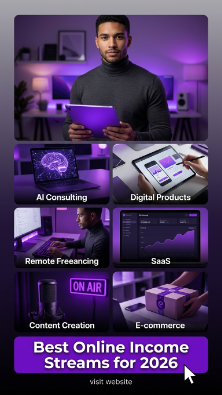
The Complete Guide to Building Wealth in the New Digital Economy
The digital economy has undergone a profound transformation. What worked as an online side hustle in 2020 looks almost quaint compared to the sophisticated, technology-driven opportunities available in 2026. The creator economy has exploded from $250 billion to a projected $480 billion by 2027, with approximately 50 million people now working as creators globally . The gig economy is no longer a fringe experiment—it’s a fundamental restructuring of how work gets done.
This 3,000-word guide examines the most promising online income streams for 2026, organized by strategy, effort level, and income potential. Whether you’re looking to replace your full-time income or build a supplementary revenue stream, the opportunities covered here reflect the realities of today’s digital marketplace.
Understanding the 2026 Digital Income Landscape
Before diving into specific income streams, it’s essential to understand the macro trends shaping online earning in 2026.
The AI Revolution Is Reshaping Everything
Artificial intelligence has moved from experimental tool to essential infrastructure. AI shopping agents are beginning to autonomously discover, evaluate, and purchase products on consumers’ behalf, fundamentally changing how brands compete for visibility and relevance . This shift creates both opportunities and challenges for online earners—those who understand how to work with AI rather than against it will thrive.
NielsenIQ research reveals that AI is rapidly becoming “the buyer, not just the tool,” reshaping how products are discovered, chosen, and purchased . This means content creators and digital entrepreneurs must optimize not just for human audiences, but for AI algorithms that increasingly influence purchasing decisions.
Remote Work Is the New Normal
By 2026, remote work is no longer a pandemic-era experiment—it’s a core component of how modern organizations operate. The key changes include tighter hybrid structures, with employers typically expecting about 3.2 office days per week while employees average about 2.9 days . This hybrid reality creates significant demand for digital roles in software development, data analysis, cybersecurity, digital marketing, and product design .
Companies are no longer limited by geographic boundaries when hiring, which intensifies competition for top talent but also opens global opportunities for skilled workers .
Social Commerce Is Going Mainstream
Social commerce and live-stream shopping are expanding global discovery channels. TikTok Shop and platforms like Whatnot have demonstrated that the gap between content and commerce can be closed entirely . In the US, social commerce is growing at 62.9%, far outpacing traditional e-commerce growth . For online earners, this means new opportunities to monetize audiences directly.
Category One: Creative and Digital Products
1. Online Courses and Digital Education
The global e-learning market is projected to reach $465 billion by 2028, making online education one of the most lucrative digital income streams . If you possess specialized knowledge—whether in professional skills, hobbies, or academic subjects—creating an online course can generate substantial passive income.
How it works: Platforms like Teachable, Udemy, and Kajabi allow you to create, host, and sell courses to a global audience. Once the course is built, it can continue generating income for years with minimal maintenance.
Income potential: $500 to $10,000+ per month, depending on course quality, marketing, and subject matter demand .
Best for: Subject matter experts, professionals with specialized knowledge, educators, and skilled hobbyists.
Pro tip: The most successful courses solve specific problems for defined audiences. Rather than creating a “how to start a business” course, niche down to “how to launch a D2C skincare brand in 90 days” .
2. Digital Products and Templates
The market for digital products has matured beyond basic printables. Today’s high-earning creators develop sophisticated digital assets that function as systems rather than simple templates .
What’s working in 2026:
- Resume and interview kits for specific industries (tech, MBA programs, government exams)
- Notion dashboards for productivity and workflow management
- Brand kit systems for small businesses
- Presentation decks for startups and pitch competitions
- Industry-specific financial models and calculators
Income potential: $100 to $2,000+ per month, with top creators earning substantially more through high-value product bundles .
Best for: Organized individuals with expertise in particular workflows or industries. The key shift in 2026 is that buyers don’t want “designs”—they want “systems” .
3. User-Generated Content (UGC) Creation
UGC has exploded from a marketing buzzword to a $12 billion industry in 2026, projected to reach $15 billion by 2027 . Unlike influencer marketing, UGC creators don’t need large followings—brands pay for authentic-looking content that mimics real customer experiences.
What UGC creators do: Product demos shot at home, “before/after” style videos, lifestyle clips for ads, and voiceover product reviews. The content should look genuine and phone-shot rather than professionally produced .
Income potential: Creators are typically paid per video, with rates ranging from $50 to $500+ depending on complexity and brand size . Many creators work with multiple brands simultaneously, building substantial monthly income.
Why it’s strong in 2026: Brands trust UGC more than polished ads, demand is rising with Instagram Reels and YouTube Shorts, and 78% of consumers prefer UGC to traditional advertising .
Best for: Creative individuals comfortable on camera who can produce content quickly and consistently.
4. Self-Publishing on Amazon KDP
Self-publishing has evolved beyond traditional books. In 2026, “low-content” books—journals, planners, coloring books—are particularly lucrative because they require less writing skill but can generate passive royalties .
How it works: Create a book or journal using Canva or similar tools, upload to Kindle Direct Publishing (KDP), and earn royalties on each sale. Amazon handles printing, shipping, and customer service.
Income potential: Variable, but many self-publishers earn steady monthly income from established catalogs. Specialized fiction in growing genres (young adult, queer horror) and self-help remain strong sellers .
Best for: Writers, designers, and organized individuals who can produce content systematically.
Pro tip: Wealth coach Halle Eavelyn recommends focusing on specialized niches where competition is lower. “You don’t need to be Hemingway—just organized,” she notes .
5. Stock Photography and Video
Selling stock content remains one of the most established passive income streams. Shutterstock has already paid out over $1 billion to contributors as of 2024 .
What sells: Authentic lifestyle photography, diverse representation, and video clips of everyday activities. Companies need images of people cooking, working from home, playing with children, and engaging in common activities .
Income potential: $100 to $3,000+ per month based on portfolio size and quality .
Best for: Photography enthusiasts with good equipment and an eye for composition.
Category Two: AI and Tech-Enabled Income
6. AI Automation Setup for Small Businesses
This is quietly becoming one of the most in-demand freelance skills in 2026. Small businesses (clinics, coaching centers, D2C brands, and real estate agents) need help implementing AI tools but lack technical expertise .
What you’d build:
- Automated reply systems (WhatsApp/Instagram DM flows)
- Lead capture forms connected to Google Sheets/CRM
- Content scheduling systems using AI tools
- Basic customer support bots
Income potential: This is closer to “digital consultancy” than gig work. One setup project can turn into monthly maintenance income, with freelancers earning $50-$200+ per hour depending on complexity .
Why it works in 2026: Businesses want automation but lack technical skills, no-code tools have made setup easier (not less needed), and ongoing maintenance creates recurring revenue .
Best for: Tech-savvy individuals comfortable with no-code tools and workflow automation.
7. Short-Form Video Editing
Attention spans are shorter than ever, and content creators need a constant stream of engaging short videos for platforms like TikTok, Instagram Reels, and YouTube Shorts . Demand for editors is consistent—not seasonal—and AI tools actually increase output, allowing editors to handle more clients.
What editors are expected to handle: Fast cuts and pacing for retention, subtitles and hook text, meme-style transitions, and repurposing long videos into shorts .
Income potential: Stable freelance income. Many editors work with multiple content creators, charging per video or monthly retainers.
Why it’s profitable: Every creator needs 10–30 shorts a week, making this one of the most stable freelance income streams .
Best for: Detail-oriented individuals with video editing skills and software proficiency.
8. Voice Work and AI Voice Licensing
Voice-over work for videos, ads, and internal content remains in steady demand. Additionally, AI companies pay for voice samples to train virtual assistants and speech models .
Voice-over rates: $20 to $200 per project, with rates increasing as you build client relationships .
AI voice licensing: $100 to $1,000+ per project, and once recorded, it’s fully passive income requiring no ongoing work .
Best for: People with clear, pleasant speaking voices and basic home recording equipment.
Category Three: E-Commerce and Product Sales
9. Print-on-Demand (POD)
AI tools have dramatically lowered the barrier to entry in print-on-demand. With platforms like Printful and Redbubble, anyone can create custom merchandise without holding inventory .
How it works: You upload designs for t-shirts, mugs, posters, and more. When a customer buys, the supplier handles production and shipping. You never touch the product.
Market size: The global print-on-demand market was valued at $6.18 billion in 2022 and is projected to grow at 25.8% CAGR through 2030 .
Income potential: $100 to $5,000+ per month, with success depending on design quality and marketing .
2026 advantage: AI tools mean anyone can create designs. Wealth coach Halle Eavelyn suggests making five designs on Canva, uploading to Printful, and letting social media “do its thing” .
Best for: Creatives with design skills or willingness to learn, and marketers who understand social promotion.
10. Dropshipping
Dropshipping lets you sell products without holding inventory. You set up an online store (typically on Shopify or WooCommerce) and forward orders to suppliers who handle fulfillment.
Income potential: $200 to $5,000+ per month, though success depends on smart product selection and effective marketing .
2026 considerations: Cross-border e-commerce has become more complex with shifting tariff regimes, de minimis rule changes affecting low-value imports into the US and EU, and expanding data localization requirements . Successful dropshippers must navigate these regulatory challenges.
Best for: Entrepreneurs comfortable with digital marketing and supply chain management.
11. Live Social Selling
Live social shopping hosts sell products in real-time on platforms like TikTok Shop, Instagram Live, and Whatnot. This community-driven experience makes it easy for global audiences to engage with brands .
Market opportunity: The global live commerce market is expected to reach $3.48 billion by 2030, with a 21.2% CAGR from 2024 to 2030 .
Income potential: Highly variable, with top hosts earning substantial commissions. Some sellers earn tens of thousands of dollars in a single day through live-streaming sales .
Best for: Charismatic individuals comfortable on camera with strong sales instincts. Deep niche knowledge and community engagement are essential.
Category Four: Service-Based Income
12. Niche Freelance Consulting
General freelancing is getting crowded. The winners in 2026 are people who go very narrow and very specific .
Examples of niche consulting:
- “Instagram growth for dentists”
- “Resume optimization for software engineers”
- “Email marketing for Shopify brands”
- “Sales script writing for real estate agents”
Income potential: Specialization allows higher pricing per client. Even a small client base can turn into stable monthly income with proper positioning .
Why it works: Businesses don’t want generalists anymore. Specialization builds reputation in a micro-category and commands premium rates .
Best for: Professionals with deep expertise in specific industries who can package their knowledge as services.
13. Online Tutoring and Test Prep
If you’re strong in a subject people want to learn—test prep, writing, math, resume coaching—tutoring offers a low barrier to entry. Many tutors start with just a laptop and a few clients, then raise rates as demand grows .
Income potential: Some tutors have turned this into six-figure businesses working limited hours .
Best for: Subject matter experts, teachers, and professionals with specialized knowledge.
14. Virtual Assistant Services
Organized individuals with a firm understanding of office software can perform freelance office work from home. The demand for virtual assistant services has grown dramatically with the shift to remote work .
What VAs do: Administrative tasks, email management, scheduling, data entry, customer support, and social media management.
Income potential: Varies by skill level and services offered, typically $20-$75 per hour.
Best for: Organized, detail-oriented individuals with good communication skills.
15. Search Engine Evaluator
Search engine evaluators rate the accuracy of search engine results by following specific guidelines. It requires no special experience and offers flexible hours .
How it works: You work online, following guidelines to determine search intent and rating relevance. You can log on and work at any convenient time, as long as you complete required hours each week .
Income potential: Typically $14-$25 per hour, with flexibility being the main benefit.
Best for: Anyone with good judgment and attention to detail who wants a flexible, remote position.
16. Transcription and Subtitling
Streaming platforms need subtitles in multiple languages. Bilingual or detail-oriented individuals can earn $30 to $50 per hour through platforms like Rev and Amara .
Best for: Fast typists with excellent listening skills. Bilingual skills command premium rates.
17. Online Mock Juror
Law firms use mock juries to test how arguments will land. Participants earn $20 to $60 per case by listening to case presentations and providing opinions .
Best for: Anyone interested in the legal system who can provide thoughtful feedback.
Category Five: Renting and Sharing Economy
18. Rent Out Your Assets
Peer-to-peer rental platforms make it easy to monetize items you already own .
What you can rent:
- Parking spaces or storage areas ($20-$450/month)
- Tools and equipment ($20-$300+ per half-day)
- Vehicles via Turo (average $634/month per vehicle)
- Boats via Boatsetter (average $20,000/year)
- Spare rooms ($600-$1,400/month for long-term, $89/night average for Airbnb)
Best for: People with underutilized assets and willingness to manage rental logistics.
19. Rent Out Your Computer’s Processing Power
Cryptocurrency miners will pay you to leave your computer running overnight. You’re essentially renting out your processor during idle time .
Income potential: Modest but requires zero effort after setup.
Best for: Tech-savvy individuals who keep their computers running anyway.
Category Six: Financial and Investment Income
20. High-Yield Savings and CDs
For those in the early stages of financial building, interest-bearing accounts provide truly passive income without risk .
Options: High-yield savings accounts (HYSA), certificates of deposit (CDs), and money market accounts. CDs offer guaranteed returns with APYs typically higher than regular savings accounts, though funds are locked for a set period .
Best for: Anyone with savings who wants risk-free returns, particularly those building emergency funds.
21. Dividend Investing and Index Funds
Dividend-paying stocks and exchange-traded funds (ETFs) provide regular income from investments. Low-turnover index funds are particularly efficient for passive investors .
Best for: Those with capital to invest who want regular income without active management.
22. Cryptocurrency Investment
According to wealth coach Halle Eavelyn, buying crypto in 2026 is “like picking up Amazon stock back when everyone thought online shopping was a fad.” She recommends making small recurring investments through platforms like PayPal or Cash App .
Important note: Crypto is volatile and carries significant risk. Only invest what you can afford to lose.
Best for: Risk-tolerant investors who believe in long-term crypto adoption.
Strategic Considerations for 2026
Start Where You Are
Not every income stream makes sense at every stage of your financial journey. If you’re focused on paying off debt, zero-cost options like renting a spare room or selling digital products using existing skills are appropriate. If you’re building an emergency fund, a high-yield savings account is the logical choice. Rental properties and larger investments should wait until you’re financially stable .
Realistic Expectations About Passive Income
It’s crucial to understand that passive income is rarely passive at the start. Every method requires time, effort, money, or some combination to get going. Building digital products, creating content, investing, or setting up systems requires upfront work. The income may become more hands-off later, but something must be built first .
The Three Pillars of 2026 Online Income
The strongest income streams in 2026 share three characteristics :
- They’re tied to AI or digital workflows
- They solve a business problem (not just a creative hobby)
- They scale without requiring physical expansion
Data Quality Is Infrastructure
Across e-commerce, content creation, and digital services, data quality has become critical infrastructure. AI shopping agents encountering inconsistent product information or ambiguous availability signals will simply move to competitors. Retailers and content creators who prioritize clean, structured data will capture more opportunities .
Conclusion: Building Your 2026 Online Income Portfolio
The best approach to online income in 2026 is diversification—building multiple streams that complement each other and reduce risk. A typical successful portfolio might include:
- One creative income stream: Digital products, courses, or UGC creation
- One service income stream: Niche consulting, video editing, or AI automation
- One investment income stream: High-yield savings, dividends, or crypto
- One product income stream: Print-on-demand, dropshipping, or asset rental
The key is to pick one or two streams that fit your skills and circumstances, start small, and let results build over time. As the Dad is FIRE blog aptly states, “Lazy money isn’t about doing nothing—it’s about making your time work harder than you do” .
The digital economy of 2026 offers unprecedented opportunities for those willing to adapt, learn, and build systems that generate income beyond the traditional paycheck. Whether you’re looking to escape the 9-to-5 or simply create financial breathing room, the streams covered in this guide provide a roadmap to success in the new digital economy.