 admin
admin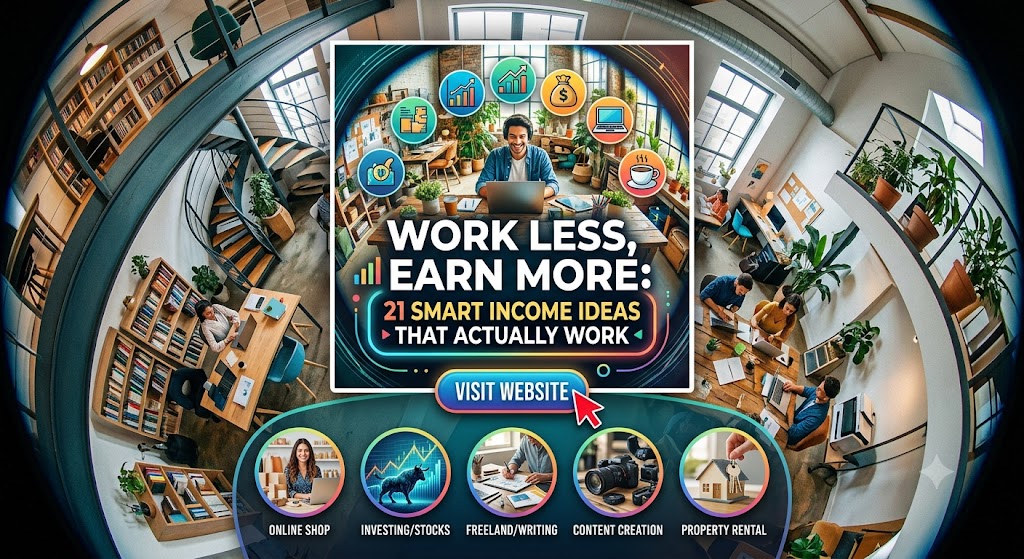
The Millionaire’s Blueprint: 10 Radical Strategies to Work Less and Earn More in the Modern Economy
The “Hustle Culture” that dominated the early 2010s is dying. For years, we were told that the only path to success was to “grind” 24/7, sacrifice sleep, and outwork everyone else. But as the global economy shifts towards automation, artificial intelligence, and digital leverage, the old rules of “Time = Money” are no longer just outdated—they are a recipe for burnout and financial stagnation.
In the modern world, the most successful people aren’t the ones working the most hours; they are the ones who have mastered the art of leverage. They have learned how to decouple their income from their time, allowing them to earn exponentially more while working significantly less.
This is not a “get rich quick” manual. It is a strategic guide to shifting your mindset and your business model from linear growth to exponential freedom. If you want to join the ranks of the “New Rich,” here are the strategies to work less and earn more.
1. The Power of Leverage: Moving Beyond Linear Income
To work less and earn more, you must utilize the four types of leverage:
Labor Leverage
This is the oldest form of leverage. You hire people to work for you. While effective, it is also the most difficult to manage, as it involves human emotions, payroll, and management overhead.
Capital Leverage
Money is a force multiplier. If you have $1 million and you earn a 10% return, you’ve made $100,000 without lifting a finger. Capital is a “clean” form of leverage, but it requires initial wealth to begin.
Code Leverage (Software)
This is the “new” leverage. You write code once, and it works for you while you sleep. Whether it’s an app, a SaaS (Software as a Service) platform, or a simple script, code never gets tired and costs nearly nothing to replicate.
Content Leverage (Media)
Like code, media (books, blogs, podcasts, YouTube videos) is a form of “permissionless” leverage. You don’t need a boss’s permission to record a video or write an article. Once created, that content can be consumed by millions of people simultaneously, generating income through ads, sales, or leads 24/7.
2. Apply the 80/20 Principle to Your Life and Business
The Pareto Principle states that 80% of your results come from 20% of your efforts. Most people spend the majority of their day on the “thick of thin things”—emails, low-level admin, and “busy work” that doesn’t actually move the needle.
Start a Profitable Blog
Create helpful content in a profitable niche and monetize it through ads, affiliate marketing, and sponsored posts.
2. Build an Affiliate Marketing Business
Promote trusted products and earn commissions whenever someone purchases through your referral links.
3. Sell Digital Products
Design eBooks, templates, printables, or online courses that can be sold repeatedly with little ongoing effort.
4. Launch a YouTube Channel
Create evergreen videos that continue generating ad revenue and affiliate commissions long after they’re published.
5. Offer Freelance Services
Use your existing skills in writing, graphic design, programming, or marketing to earn premium rates.
6. Create an Online Course
Package your expertise into a course that students can purchase anytime.
7. Start a Print-on-Demand Store
Sell custom apparel, mugs, and accessories without managing inventory.
8. Open a Dropshipping Business
Run an online store while suppliers handle storage and shipping.
9. Invest in Dividend Stocks
Generate recurring income from companies that regularly distribute profits to shareholders.
10. Rent Out Your Assets
Earn extra cash by renting out a spare room, parking space, camera equipment, or vehicle.
11. Sell Stock Photos and Videos
Upload quality content to stock marketplaces and earn royalties whenever your work is downloaded.
12. Become a Virtual Assistant
Help businesses remotely with administrative, customer support, or scheduling tasks.
13. Create a Membership Website
Offer exclusive content, tutorials, or resources through a monthly subscription.
14. Develop a Mobile App
A useful app can generate recurring revenue through subscriptions or advertising.
15. Write and Publish an eBook
Self-publishing allows you to earn royalties for years from a single project.
16. Invest in REITs
Real Estate Investment Trusts provide exposure to real estate without buying physical property.
17. License Your Creative Work
Music, illustrations, photography, and designs can earn ongoing licensing income.
18. Build a Niche Website
Focus on a specific topic and monetize with affiliate marketing and display ads.
19. Sell AI-Powered Services
Use AI tools to deliver content creation, marketing, design, or automation services more efficiently.
20. Automate an Online Business
Use automation tools for email marketing, customer support, and sales to reduce manual work.
21. Diversify Your Income Streams
Combine several of these ideas to create multiple sources of income, making your earnings more stable and scalable.
3. Transition from Hourly Billing to Value-Based Pricing
If you are a freelancer or a consultant, billing by the hour is a self-sabotaging practice. It punishes you for being efficient. If a project takes you 10 hours instead of 20 because you are an expert, you shouldn’t be paid half as much; you should be paid more because you delivered the result faster.
The Value-Based Model
Instead of saying, “My rate is $100 an hour,” you should say, “This project will cost $5,000.”
Why? Because the client isn’t buying your time; they are buying a result. If your marketing campaign generates $50,000 in new revenue for a client, they won’t care if it took you five minutes or five months to create. By pricing based on the value delivered to the client, you remove the ceiling on your earning potential.
4. Build a “Learn Once, Sell Always” Digital Product
The ultimate way to work less and earn more is to create a product that has a zero marginal cost of reproduction.
In the physical world, if you sell a chair, you have to buy materials and spend time building another chair to sell it again. In the digital world, once you create an e-book, a template, or an online course, you can sell it to 1,000 or 1,000,000 people without any additional work.
Profitable Digital Product Ideas:
- Online Courses: Package your expertise into a structured curriculum. Platforms like Teachable or Kajabi make this easy.
- SaaS (Software as a Service): Solve a specific problem with a simple software tool.
- Premium Templates: If you are a pro at Notion, Excel, or Canva, sell your workflow templates.
- Paid Newsletters: Provide curated, high-value information to a niche audience.
Digital products allow you to earn “passive income”—money that flows in regardless of whether you are sitting at your desk or sitting on a beach.
5. Master the Art of Ethical Outsourcing
You cannot scale yourself, but you can scale a system. Many entrepreneurs get stuck because they believe “no one can do it as well as I can.” This is the “Founder’s Trap.”
To work less, you must become a manager of systems rather than a doer of tasks.
Where to Hire:
- Virtual Assistants (VAs): Use platforms like OnlineJobs.ph or Upwork to find high-quality help for administrative tasks, data entry, and research.
- Specialized Freelancers: Use Fiverr Pro or Toptal for high-level tasks like graphic design, web development, or copywriting.
- AI as an Employee: Before hiring a human, ask if an AI tool can do it. Tools like ChatGPT for writing, Midjourney for images, and Otter.ai for transcriptions are effectively “digital employees” that cost a fraction of a human salary.
6. High-Value Skill Acquisition: Become a “Category of One”
The less replaceable you are, the more you can charge, and the less you have to work to maintain your lifestyle. If you have a common skill, you are a commodity. If you have a rare and valuable skill, you are a monopoly.
Skills that Command High Fees:
- AI Implementation: Helping businesses integrate AI into their workflows.
- High-Ticket Sales: Closing deals that worth $10k, $50k, or $100k.
- Copywriting: The art of selling through the written word.
- Strategic Consulting: Solving complex business problems that others can’t see.
Instead of being a “jack of all trades,” become the absolute best in a very specific niche. When you are the only person who can solve a specific problem, you dictate the terms and the price.
7. Automate Everything with No-Code Tools
We are living in the golden age of automation. You no longer need to be a programmer to build complex systems that run your business for you. “No-code” tools can connect different apps and handle repetitive workflows automatically.
Essential Automation Tools:
- Zapier / Make: These act as the “glue” between apps. For example, when a customer buys a product on Shopify (Trigger), Zapier can automatically add them to an email list in Mailchimp, send them a thank-you text via Twilio, and update your accounting in QuickBooks (Actions).
- Calendly: Eliminates the “back and forth” of scheduling meetings.
- ConvertKit: Automates your entire marketing funnel through email sequences.
By spending 10 hours setting up a robust automation system today, you can save 1,000 hours over the next year.
8. The “Media First” Strategy: Build a Personal Brand
In the 21st century, attention is the new currency. If you have an audience that trusts you, you have an infinite number of ways to monetize that attention without having to work a traditional job.
A personal brand is a moat. It protects you from competition. People might be able to copy your product, but they can’t copy you.
How to Build Leverage Through Brand:
- Pick One Platform: Don’t try to be everywhere. Choose the one that fits your strengths (Twitter/X for writing, YouTube for video, LinkedIn for professional networking).
- Provide Massive Value for Free: Share your secrets, your journey, and your failures.
- The “Permissionless” Salesman: Your content acts as a salesman that never sleeps. It introduces you to potential clients and customers 24 hours a day, so by the time you actually talk to someone, they are already sold on your expertise.
9. Psychological Shift: The “New Rich” Mindset
Working less and earning more requires a fundamental psychological shift. You have to stop feeling guilty for not being “busy.”
The Difference Between Busy and Productive:
- Busy: A full calendar, constant notifications, feeling overwhelmed, reactive.
- Productive: A clear calendar, deep work sessions, feeling in control, proactive.
The “New Rich,” a term coined by Tim Ferriss, value Time and Mobility over status and possessions. They realize that a person earning $60,000 a year with total control over their time is “richer” than a corporate executive earning $300,000 a year who has no time to see their family or travel.
10. Invest for Passive Cash Flow
Finally, once you begin earning more by working less, you must put that excess capital to work. The goal is to reach a point where your investments cover your lifestyle expenses. This is the definition of true financial freedom.
Income-Generating Assets:
- Dividend-Paying Stocks: Earning a share of corporate profits.
- Real Estate: Rental income provides monthly cash flow and tax advantages.
- Index Funds: Long-term wealth building through the growth of the entire market.
- Private Equity/Angel Investing: Investing in other people’s businesses (using their labor and code as your leverage).
The Roadmap: How to Start This Week
You don’t have to quit your job or flip your entire business overnight. The transition to “Working Less and Earning More” is a series of small, strategic pivots.
Phase 1: The Audit (Days 1–7)
Track your time. Identify your 20% high-value tasks. Cancel all unnecessary meetings. Install an ad-blocker and turn off social media notifications.
Phase 2: The Automation (Days 8–14)
Pick one repetitive task and automate it using a tool like Zapier. Set up a scheduling link to stop the email tag for meetings.
Phase 3: The Delegation (Days 15–21)
Hire a freelancer or VA to take one recurring, low-value task off your plate (e.g., social media posting, lead research, or bookkeeping).
Phase 4: The Productization (Days 22–30)
Think of one piece of knowledge you have. Create a simple PDF guide or a 15-minute video training and put it up for sale or use it as a lead magnet to build your audience.
Conclusion: The Choice is Yours
The “40-hour work week” is a social construct from the industrial revolution. We no longer live in an industrial economy; we live in an information and leverage economy. In this new era, the rewards go to those who think clearly, build systems, and utilize technology to multiply their output.
Working harder is a linear path. Working smarter, through leverage and automation, is an exponential one. By applying the principles of the 80/20 rule, value-based pricing, and digital assets, you can break the chains of the clock and build a life of both high income and high freedom.
Stop glorifying the “grind” and start glorifying the result. Your time is the only non-renewable resource you have. Spend it wisely.